Community-based Forest Conservation
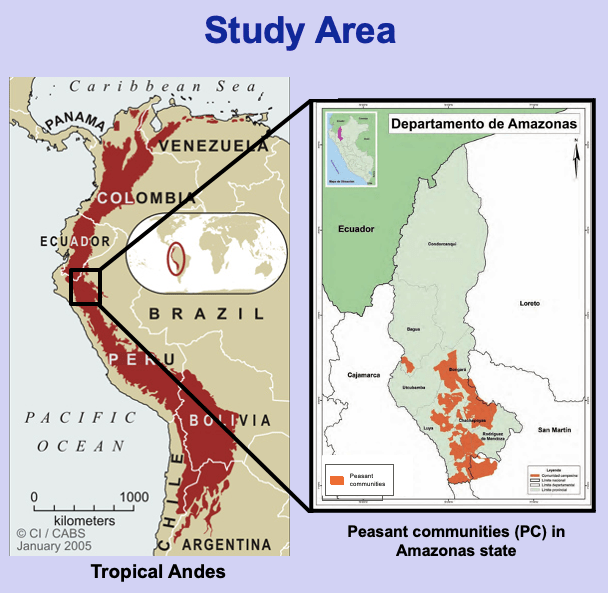
This research seeks to understand the individual and integrated contribution of drivers of forest cover loss in peasant communities (PC) which conserve forest lands in a portion of their territory. A combination of socioeconomic and infrastructure development data was used to compare forest cover loss on peasant communities’ lands located in the Andes of northern Peru. An important locally-enacted cause of forest cover change in the region has been the combined effect of the expansion of small-scale grazing, the proximity to a coastal city, road infrastructure inside each community, and a household-based indicator of wealth. This study also aims to evaluate the effectiveness of forest conservation interventions led by rural communities in mitigating forest cover loss by creating conservation areas (or ACP). Using Elinor Ostrom’s approach this preliminary study evaluated factors that enable and limit effective governance of collectively owned forests. The legal framework for private conservation areas was implemented in Peru in 2001 and is an example of an increasingly common conservation strategy in Latin American countries to mitigate environmental degradation.
 Vanessa Luna-Celino